As well as the standard arithmetic functions the Lloytron also offers square roots, squares, reciprocals and percentages.


The Prinztronic MC66 was a meaty desktop AC powered calculator from the early 1970s. Made in 1973 and powered by a Rockwell 15352PA processor, the MC66 provided the basic mathematical functions, memory functions and a constant key. It had a 12 digit green vacuum fluorescent display.
The calculator has very pleasing "space age" styling, including the typeface used for the name.

This was a mass-produced calculator from HK, known as the Standard Type 1. Our example bears the name "Academy" though many other names were also carried too including "King Sonic", "Mustang 3000" and "Binatone"! All were the same calculator, manufactured in the late 1970s. The calculator is similar internally and functionally to the Texet 880A.
The calculator is powered by a Texas TMS0972NL and has the basic arithmetic functions, percentages and a memory. The display has eight digits and uses red LEDs.

Texet made this calculator in 1978 in HK, powered by a Texas Instruments TMS0972NL or a MOS MPS-7560 chip. The calculator has the basic arithmetic functions, it can handle negative numbers with the CS key and percentages.
The calculator has memory store though the eight digit red LED display has no indicator to show the memory is being used. Helpfully there are three separate keys that can clear the memory!

Also known as the Triumph-Adler EC1M (and built by Omrom in Singapore), the 814 was a large desktop calculator from 1973 built using LSI discrete logic. The calculator came in mains powered (as in my example) or battery powered versions. The calculator has the basic arithmetic functions and a memory. The calculator is designed for heavy duty number crunching in the likes of accounts or payroll departments and has a fold out stand on the back.
There are also a few other function keys along the left-hand side, what A, K, CA and CI do i don't know (though on other calculators K is used for carrying out calculations using a constant), unfortunately the calculator is non-operational. Similarly there is a sliding switch above the display, perhaps something to do with number of decimal places displayed? The display is an eight digit VFD (vacuum fluorescent display).

A couple of months ago we uploaded some scans from a Living magazine from 1973 found in Mum's loft. Another magazine has been found, My Weekly from March 1979 and here are a few scans from that. Its not as funky as the 1973 magazine to be honest but old adverts are always of interest.

A few more scans from the October 1973 Living magazine i found in my Mum's loft last week.


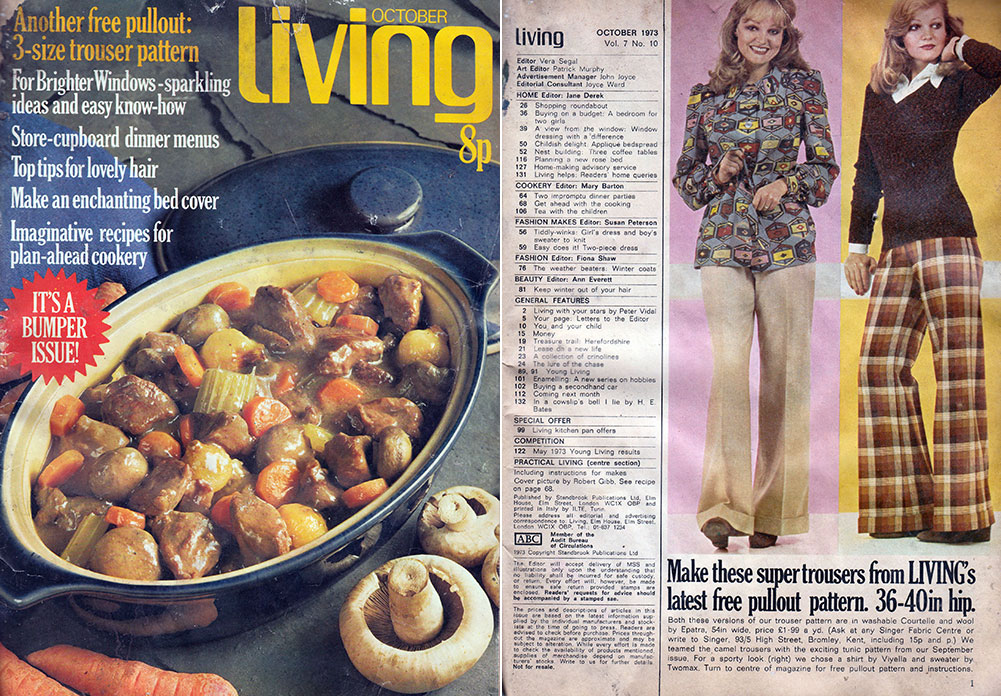
While clearing junk from my Mum's loft yesterday I discovered an October 1973 copy of Living magazine. It was in reasonable condition considering it must have been up in the loft for a number of decades, even surviving a couple of burst pipes! Quite why the magazine was up there is a bit of a mystery as it was bought a few years before my parents bought the house, no doubt for some reason now lost to the mists of time the magazine was left up there.
I am glad it survived as it offers a fascinating glimpse of life in the UK in the early 1970s. For the next few weeks let's enjoy some period adverts, styles and fashions. And truly get our 8p worth.


A lovely little film which shows how the IBM 360 mainframe works behind the scenes at a Social Security office.
Time to introduce my latest blog. I've wanted a blog based on the 1970s for some time, and have had a couple of failed attempts to get one off the ground. Love the 1970s is the latest attempt and seems to have taken flight, as it were, so i feel confident to announce it! It is a nostalgic blog which harks back to the pop culture and some major events of fifty years before. Therefore currently the blog is looking at 1970, next year will be 1971! The blog contains music videos, album and movie reviews and photos from the 1970s. I'm not sure what will happen if the blog is still around in 2030, maybe it will just change it's name to Love the 1980s!


