For the last few years I have had a Swatch but it was starting to get a bit shabby so time to get a new watch. I decided it was time to get a smart watch, an Apple Watch SE in fact. I like the fact I can see what my heart beat is and hopefully it will give me more accurate activity reporting than my phone does (as the watch should be with me for longer). It is very nice, and space grey like my Macs of course.
Monday, 28 June 2021
Wednesday, 10 March 2021
Apple & Unix : The early years
Since 2001 and the release of MacOSX, the operating system of Apple Macintosh computers has been Unix based but this was not the first time Apple developed and released a Unix for the Mac.
In 1988 Apple released A/UX which was based on Unix System, it came with a version of the Apple Mac graphical user interface and ran on select Motorola 68K Macs. It was able to run Mac and X-Windows applications. Unix commands could be run via a dialog box which also allowed the user to select command line options in a user friendly way. The initial version of A/UX included the System 6 Finder with the Finder switching to System 7's with A/UX version 3.0.
Despite the positive reaction to A/UX from some quarters, A/UX was never a great success for Apple and today remains in obscurity. Apple thought A/UX could help them get the Mac into big business and the growing enterprise market. Apple finally dropped A/UX in 1995, the already announced v4.0 never seeing the light of day.
This wasn't the end of Apple's pre-MacOSX Unix efforts though. In 1994 they released the Macintosh Application Environment for Solaris and HP/UX. It could allow Macintosh applications to be run on Unix computers from Sun and HP. It again used a version of the Mac OS 7 Finder and special tools for importing and exporting to and from the Mac and X environments. MAE was discontinued in 1998. Thus ending Apple's involvement with Unix... well for the time being...
![]() |
| Screenshot from WinWorld https://winworldpc.com/product/a-ux/3x |
Thursday, 11 February 2021
Welcoming Sophie
My Chromebook Pixel has had a good hard life but it has finally come time to replace it. The screen is flickering, the keyboard slightly broken and Google support ends later this year. The Pixel has been replaced by a MacBook Air. This is my first computer with an ARM based chip (not counting the various iPhones and iPads I have had in the past). Hopefully, Sophie (as she has been called) will have just as long a working life as the Pixel (though I will try and not break the keyboard on this one!)
Of course, I bought a Mac mini last year called Emily which remains my main workstation, whereas Sophie is my personal assistant. For the first time I have two new (or new-ish) computers to hand. Which is nice.
Thursday, 28 January 2021
Apple beige
Apple Computer attracts the kind of obsessive attention to detail from users and fans which no other computer manufacturer has ever achieved. Let's face it, only Apple could drive someone to delve into great lengths to discover what actual colour the company's earliest computers were. They were supposed to be Apple beige but like everything else surviving examples (like my Apple IIe below - this model was a slightly darker beige than earlier Apple IIs by the way) may have shifted in colour after exposure to light. So, what actual colour was the beige these computers were created in during the late 1970s and early 1980s? The article is worth visiting alone for the photo of the Apple Computer beige touch-up paint jar, that must be a very very rare surviving Apple artifact!
Monday, 19 October 2020
Copland, the mythical beast unveiled
Copland was one of Apple's biggest failures. It was an attempt to bring MacOS up-to-date in the early to mid 1990s but after several years of expensive development and project chaos, Apple was left with a mess which would crash even if you blinked too fast. Copland was cancelled, not even making it to a proper developer release and Apple looked elsewhere for the future, which ended up being MacOSX...
But Copland has been lost to time, or has it? A few builds did make it out into the wild and on this blog the sheer horror of build D7E1 is revealed (yes it crashes a lot). It did introduce a lot of technology which made it into subsequent versions of MacOS however. To me Copland is a bit of a mythical beast so seeing this video is like seeing footage of Bigfoot walking down Erdington High Street.
Monday, 6 July 2020
Upgrading our systems
Emily is our first main computer without a traditional hard drive (it has an SSD) and no CD drive. Although Miriam's CD drive was hardly ever used especially in recent years, it will be interesting to see if the lack of a drive on the new computer will end up being a problem or not. Miriam is always available if we need to check a CD-ROM of course...
Wednesday, 29 January 2020
Restoring a 6502
The 6502 is one of the iconic early CPUs of the microcomputer revolution in the 1970s being first produced in 1975, powering the likes of the Apple II (my IIe seen below). Amazingly the CPU is still produced today and used in many embedded systems.
Tuesday, 26 November 2019
History of the World in Apple Objects (15) : Macintosh LC
It went on sale between 1990 and 1992 later superseded by the LC II and LC III, one of which I did have once too.
Tuesday, 19 November 2019
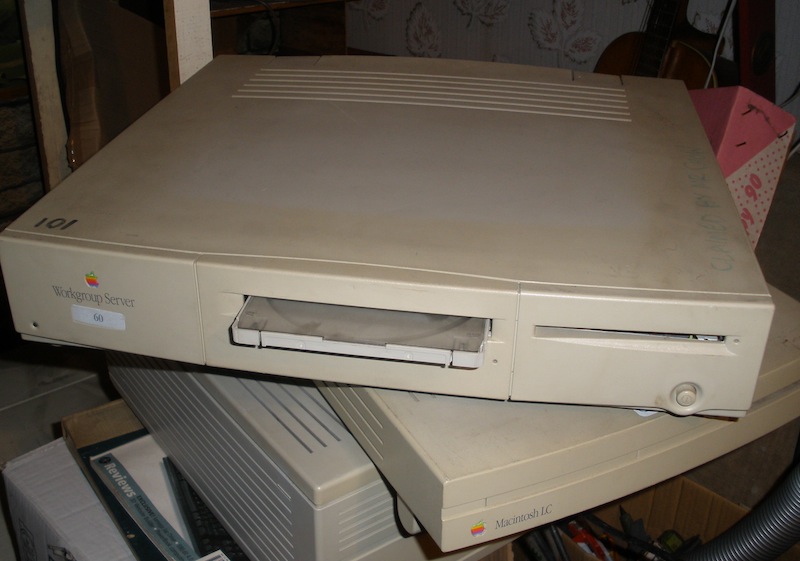
History of the World in Apple Objects (14) : Workgroup Server 60
It had a Motorola 68LC040 processor, 4MB of RAM, an 80MB hard drive and mine has a CD-ROM (an early type of CD-ROM at that with a CD caddy). Not a bad computer for it's day!
Tuesday, 12 November 2019
History of the World in Apple Objects (13) : Macintosh IIcx
The IIcx ran Mac OS 6 up to 7.5.5. Unfortunately this one is unlikely to run anything anymore though still has the cute case!
Wednesday, 5 June 2019
Augmented reality
However I thought it would be more interesting to take my virtual Mac Pro for a walk around the business park at lunchtime. The technology is really interesting and it would be cool to try developing something with AR one day, it will probably have to wait until I get my next computer though as my ancient Macbook is a bit wheezey these days. My next computer won't be a Mac Pro though due to cost (unless I win the lottery)...
Monday, 19 November 2018
Return of the TwiggyMac
It has been assumed that none of the Twiggy drive equipped Macintosh prototypes had survived as Apple had had them all recalled and destroyed in 1983. However one was found and later on another one turned up too!
After some restoration work the Twiggy Macs now work again and could boot from the original Twiggy system disks which included a beta version of Mac OS from August 1983. This version of the eventual first release of Mac OS included some intriguing differences from the final version including "Steve sez" in dialogue boxes. The whole story is recounted in the highly enjoyable Twiggy Mac website.
![]() |
| Heres how it ended up looking, my 512K |
Monday, 12 November 2018
Apple, NeXT, Be and Steve Jobs
In the mid-1990s Apple was struggling. MacOS was becoming out of date and attempts to create a new more modern version were failing hard. Apple looked to buy in an existing operating system to form the basis of the MacOS replacement. In the end they chose NeXT Computer (another company founded by Steve Jobs) and Next's operating system became the basis of Mac OSX. It nearly wasn't this way though, BeOS was also a contender and it is interesting to consider how (Apple) history and maybe the history of the world would have been different if BeOS had been the chosen system.
![]() |
| NeXT Cube |
Monday, 5 November 2018
Creating the Apple Lisa (and Mac) user interface
What is especially interesting how the Apple UI, with elements still familiar and used today such as the menu at the top, evolved. Early in the Lisa GUI development a softkey menu along the bottom of the screen was the direction the developers took before the abrupt change to a window and mouse based design. Inspired / stolen from Xerox PARC? Well various theories abound, i'm sure there was plenty of inspiration taken but some elements of the GUI are said to predate that.
It is interesting that in 1980 the Lisa had a menu on the top of windows (like Microsoft Windows later went with) instead of along the top of the screen as how the final design used.
Tuesday, 12 June 2018
History of the World in Apple Objects (12) : Macintosh IIci
It came in a very nice compact case which remains one of my favourite Apple Computer cases. The top is easily removable so you can get at the innards and perform repairs or upgrades. A far cry from today's super locked down units. I'd love a modern Mac in such a case to be honest.
Tuesday, 5 June 2018
History of the World in Apple Objects (11) : PowerMac 7200
My 7200 was a work station at my first employer Tw2, used for producing web sites. Later it became a dedicated printer workstation. I rescued it when Tw2 went bankrupt.
Tuesday, 29 May 2018
History of the World in Apple Objects (10) : A2M2002 Apple Joystick
Tuesday, 22 May 2018
History of the World in Apple Objects (9) : M0001A Mac Plus
Otherwise the Mac Plus followed the same compact format as the two earlier Macs. Also later Macs like the SE and Macintosh II family eclipsed it it remained in production as the (relatively speaking) cheap low-end Mac until 1990. It had the longest production run of any Mac model and was supported until 1997, able to run Mac OS 7.
Tuesday, 15 May 2018
History of the World in Apple Objects (8) : M1212 Apple Macintosh Color Display
The Apple Macintosh Color Display M1212 is, as you might guess, a monitor. For Macintosh computers. Although a CRT display and thus obsolete these days it did have a Trintron display so had a reasonable display for the time though only had a resolution of 640x480. It had a standard DA-15 Apple connector so could be used with a range of Mac desktops. Whether mine still works is unknown.
I can't remember where the monitor came from. It appears to have a "Faculty of C.I.S." sticker on it so perhaps it came from a university. I may have bought it off Ebay along with one of the Macintosh IIs I have though we are talking around fifteen years now since I last bought any Apple hardware off there!
Friday, 23 March 2018
The story behind Apple DOS
Apple DOS was critical in the success of the Apple II and hence Apple itself which may not have survived long enough to develop the Lisa and Macintosh if the Apple II had not been the success it was. Indeed the Apple II continued to be a success well into the late 1980s.
Apple DOS was written by Paul Laughton, and it together with Woz's disk drive and VisiCalc (the first killer app) made the Apple II a success in business. Interestingly it was developed on a minicomputer, stored on punch cards and debugged on that system before being put on Apple's microcomputer (more about this can be read here on Laughton's own website). This is nothing new of course, the Apple II itself was used to write early Lisa and Macintosh system software.