Showing posts with label 1960s. Show all posts

Wednesday, 27 October 2021

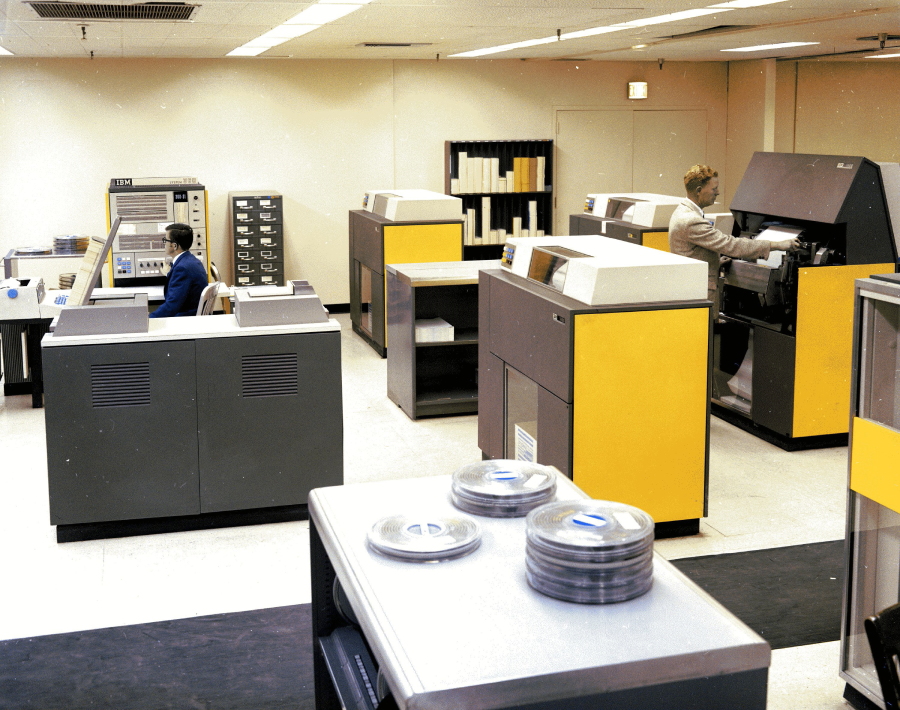
A room of old iron

A glorious photo of a computer lab from the Convair/General Dynamics Astronautics Atlas Negative Collection. Large disks, loud printers, what could be better?


Wednesday, 28 October 2020

Selling typewriters

The market for typewriters (new ones that is not vintage gear sold to obsessives like me by Etsy and eBay) is a bit small these days but back before the days of personal computers, typewriters were big business. Every office would have at least one secretary with a typewriter. 

I've always had a liking for typewriter adverts, here are four i've scanned from a calendar of "60s" adverts. More lovely typewriter adverts can be seen here.


Wednesday, 25 July 2018

From Hot Metal to Cold Type

A wonderful video showing how printing has changed (well up until the mid 1960s anyway). Old skool metal type being replaced by an array of fancy new methods including photographic equipment and chemicals. Of course nowadays producing a commercial quality publication can all be done on one computer and one printer. As I do everyday at work.

Monday, 4 June 2018

IBM 2701 Data Adaptor Unit

Mainframes in the 1960s and 1970s such as the IBM 360 were huge complicated systems which filled large rooms. Some even had smaller (in relative terms - still large compared to the average machine now) computers to help them with the amount of information that was needed to be sent into them from a number of sources. These computers were known as Front End Processors or Communication Controllers and they handled data communications allowing the mainframe to concentrate on the jobs at hand [1].

The IBM 270x family, of which the 2701 Data Adaptor Unit was a member of, was an early example of communication controller and worked with the IBM 360 and 370. The 2701 "greatly expands the input/output capabilities of the IBM System/360" [2] by helping to interface to and control information flow from peripherals like the IBM 7701 Magnetic Tape Transmission Unit. The IBM 2701 was introduced in 1964 and replaced by the IBM 3704 in 1972.
Public domain image from SDASM Archives

[1] Barry Wilkinson & David Horrocks, Computer Peripherals (Edward Arnold, 1987) p. 281
[2] IBM 2701 Data Adaptor Unit Principles of Operation (IBM, 1965) p. 5

Monday, 30 April 2018

SNOBOL (StriNg Oriented and symBOlic Language)

At first glance SNOBOL does seem like a typo of a more familiar sounding programming languages like COBOL but in fact SNOBOL is a series of languages developed at Bell Laboratories by David J. Farber, Ralph E. Griswold and Ivan P. Polonsky in the early 1960s. SNOBOL was designed for text processing and pattern matching and was quite different to most other programming languages of the time.

SNOBOL was originally developed for the symbolic manipulation of polynomials on the IBM 7090 mainframe in 1962. The language became popular and was refined and expanded culminating in SNOBOL4 in 1967.

SNOBOL4 was based on a virtual machine which meant it was much more portable. The language was popular in teaching, artificial intelligence and text manipulation in the 1970s and 1980s though it has been eclipsed by newer tools and languages in the last few decades.

More recently derived languages like SL5 and Icon have added structured language concepts to SNOBOL (which has none itself).

So how do you do a "Hello World" program in SNOBOL?

OUTPUT = "Hello world" 
END

Tuesday, 24 April 2018

The British Bus (3) : Heyday of the half-cab

As we saw in part 2 of this history of the British bus the changeover from horse to the internal combustion engine was rapid. In the 1930s the bus industry consolidated with many smaller companies swallowed up by a handful of major operators, in London and other cities municipal fleets held sway.

Following the Second World War nationalisation of transport services, which had started in the 1930s with the virtual nationalisation of London transport, was pursued in earnest to try and arrest a gradual decline in public transport in the face of growing car ownership [1]. Large bus companies like Tilling and Scottish Motor Transport were taken over by the British Transport Commission. By the late 1960s nearly all of the bus industry was publicly owned though not without opposition, Midland Red for example tried to fight nationalisation but was overruled by it's parent company [2]. This could not stop the decline in ridership however, in London for example bus passengers fell nearly fifty percent between 1951 and 1967 (mostly switching to the tube not cars).

The post-war period was the heyday of the "halfcab" bus, these had the engine at the front with the driver's cab only extended half-way across the bonnet thus facilitating easier access to the engine. The passenger entrance was usually at the rear with a conductor needed to take fares - though some half-cabs did have doors at the front. The classic halfcab buses included the Leyland Titan, Guy Arab and AEC Regent III, the latter forming the basis of the London RT just one of a series of classic London half-cab buses which were built in the thousands (seven thousand RTs alone [3]). It was in London where the half-cab remained supreme far longer than elsewhere in the country which switched to rear engined buses in the 1960s and 1970s. Indeed the ultimate example of the London half-cab bus, the Routemaster, remained in service in the capital into the early 2000s.

However elsewhere in the country the half-cab bus was being withdrawn in the late 1960s and 1970s, also time for an attempt at greater integration between the various forms of public transport. It was the time of the Passenger Transport Executive.
Former Birmingham City Transport buses, a Guy Arab on the far right

St Helens Corporation Leyland Titan PD2/47

Leyland PDR 1

RML Routemaster

Leyland Tiger FEC and Routemaster RCL

[1] Philip Bagwell & Peter Lyth, Transport in Britain 1750-2000 (Hambledon, 2002) p. 118
[2] Malcolm Keeley, Birmingham Buses Route by Route 1925-1967 (Ian Allan, 2012) p. 11
[3] Kevin McCormack, Twenty-five Years of London Transport 1949-1974 (Ian Allan, 2014) p. 49
Friday, 15 December 2017

A Xmas card on an IBM 1401

Back in the days of "old iron", when computers filled large rooms and printers were huge noisy affairs creating novely calenders and cards was quite the thing. The Snoopy calender from 1969 was something every "real programmer" had apparently. But how about using an IBM 1401 mainframe (and a 1403 printer) to create a greeting card?

Ken Shirriff (who's blog is one of the best out there to be honest) took up the challenge. It's not quite as simple as it sounds as the card needs to be folded and so normal printed text would be sideways. Here is how to do it using BDCDIC characters. The code is provided in case you have a handy 1401 yourself. Or just watch the video below.

Thursday, 13 April 2017

Tie-ins (5) : The Man From U.N.C.L.E. 7: The Radioactive Camel Affair

The Man From U.N.C.L.E. 7: The Radioactive Camel Affair by Peter Leslie

I can't really remember much about The Man From U.N.C.L.E. but was familiar enough with the characters of the show with the unwieldily acronyms to get into the book straight away. In this story THRUSH are stealing plutonium and our heroes Napoleon Solo and Ilya Kuryakin are sent to find out whats going on.

The rather mysterious title of the book stems from the cunning THRUSH plan to transport the plutonium to their secret base in Sudan by caravan. Solo follows the trail while Kuryakin follows other leads. And much of the book is taken up by what feels like an endless romp through the desert. It does get a bit dull at times.

Fear not the action hots up at the end when we get to the SEKRIT THRUSH base complete with nuclear reactor in a cave and nuclear missiles hidden under bushes. Well of course. If the desert part of the book could have been shortened somewhat it would have been all so much better but as it is the book isn't bad. Total campy 60s secret agent nonsense of course but enjoyable.

Wednesday, 5 April 2017

IBM 1403 Printer

This is an interesting feature on the IBM 1401 computer system which revolutionised computing in the early 1960s and its (or strictly the follow-on 1460's) printer the IBM 1403 which could reach 1, 100 lines per minute. An impact printer of course so rather loud. I remember the printers connected to the (Pr1me) minicomputer at university, they were so fast yet also sounded like a chain saw.

The printers were also remote, in another building from the actual computer of course. If they fouled up you never knew (if you were changing the paper) if a print job sent from someone else would come through and send everything into chaos. That counted as excitement back then.

Anyway the 1403 was fast because it was a line printer. A chain of metal embossed characters (each character on the chain 5 times) continuously revolved and the paper was pushed against the relevant character (and an ink ribbon) by tiny hammers to print a character [1]. Hence the speed... and the noise. The article comes with an interesting video history of the 1401. You can see it below too.

[1] Barry Wilkinson & David Horrocks, Computer Peripherals (Edward Arnold, 1987) p. 90

Monday, 13 February 2017

Snow Hill at the end of the 1950s

I've recently bought a good number of railway photographs from various sources off eBay, most are from the 1980s but there are also some which are a bit older. These 2 photos have written on the back of them that they are taken at Birmingham Snow Hill. The Class 26 in one of the photos is described as "ex-works" which means the photos could have been taken in 1958 or 1959. The liveries seem correct for that time period. The railway scene is completely unrecognisable (to me anyway), if it didn't say where it was on the back i'd have no idea!

Just above the loco in the first photo can be seen the company name Taylor & Challen Ltd., they were a manufacturer of lathes and metal presses in Birmingham, many of which are still in use though the company is gone (bought out by an engineering company in Erdington interestingly). The surviving buildings are now mainly apartments like much else in the Jewellery Quarter.


Monday, 21 November 2016

MV : "White room" by Cream

So i'm watching a period drama, well set in 1969 to be exact. "Good Girls Revolt" is the name and its very good, especially the inclusion of music from the era. Including the song below, sometimes i wish i had been born a couple of decades earlier so i could have experienced this scene for the first time. But then again now i would be 20 years older and have 20 years worse aches and pains. So we'll stick to Youtube.