Tuesday, 9 April 2019

Warwickshire Places (2) : Danzey Green

Danzey Green is a small village near to Tanworth-in-Arden (just over a kilometre and a half away to the North). Danzey Green is rural and it's most notable buildings is Danzey Green Farm which dates from the mid to late eighteenth century [1]. There was also once a windmill though this was already derelict by the late nineteenth century [2] having been damaged in a storm. The windmill was dismantled and moved to the Avoncroft Museum of Buildings in Bromsgrove in 1969.

Danzey railway station was opened in 1908 and still exists despite the small local population, however it was mostly intended for residents of Tanworth as the station bore the name Danzey for Tanworth for a time [3].
Stood on the railway platform, the view emphasises the rural nature of the station surroundings

The wonderfully named Pigs Trot Lane stretches away to the left

A road sign thats seen some life

Danzey Green Lane

Fields

Danzey station

[1] "Parishes: Tanworth." A History of the County of Warwick: Volume 5, Kington Hundred. Ed. L F Salzman. London: Victoria County History, 1949. 165-175. British History Online. Web. 9 April 2019. http://www.british-history.ac.uk/vch/warks/vol5/pp165-175.
[2] Nikolaus Pevsner & Alexandra Wedgwood, Warwickshire (Penguin, 1966) p. 431
[3] Vic Mitchell & Keith Smith, Stratford-upon-Avon to Birmingham (Moor Street) (Middleton Press, 2006) Fig. 55

Saturday, 6 April 2019

CPRR Diesel Gala

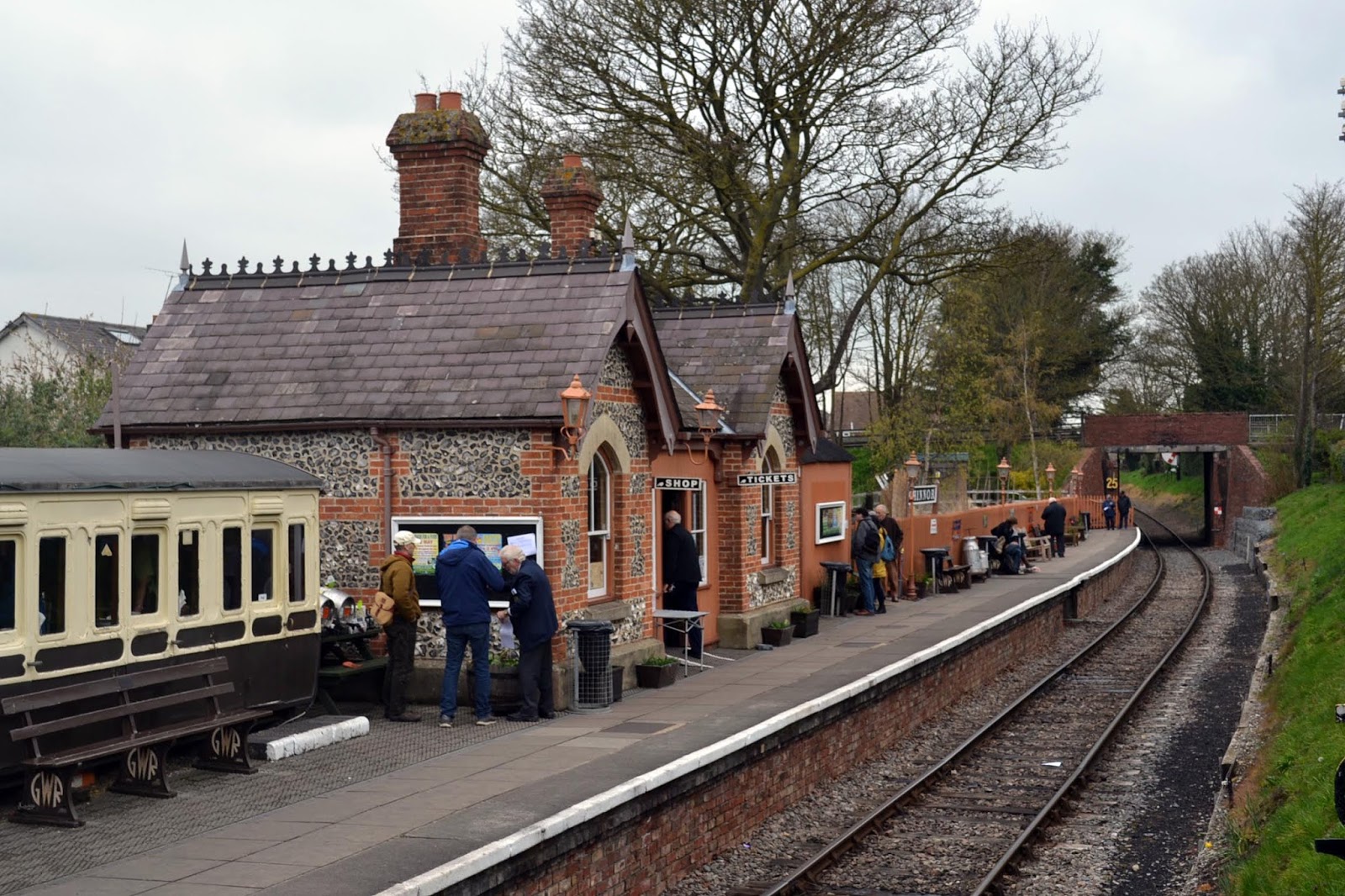
I hope to attend four or five diesel galas at preserved railway lines this year, today was the first at the Chinnor & Princes Risborough Railway (CPRR). I've been to the CPRR a few times in the past but this was the first visit since they have opened their platform next to the network Princes Risborough station which makes access to the line much easier!

You can see my photos from the gala here. I also took some photos in Chinnor and some of Bledlow as the train went past, these can be seen here.


Wednesday, 3 April 2019

BGLR : Return of Growler

Growler has returned to the BGLR as the locomotive rotation policy continues. One day the BGLR may be replaced by a much bigger layout where every loco can be present at once but until then time on metal has to be shared out. The Bear will make way for Growler within a few days once testing of Growler has been completed.

Tuesday, 2 April 2019

Warwickshire Places (1) : Wootton Wawen

The Warwickshire village of Wootton Wawen dates from Saxon times with the first records of the village dating back to the early eighth century. Æthelbald of Mercia granted Earl Aethilric twenty hides of land for a minister between 723 and 737CE [1]. A church was built on the land though the current church of St Peter & St Paul was established late in the tenth century by Wagen an Anglo-Danish landowner. He gave his name to the village, Wootton Wawen meaning a farm near a wood belonging to Wagen.

It is no surprise that the church is the oldest in Warwickshire and has some of the most notable Anglo-Saxon features of any church in the country. Another notable building in the village is the stately home Wootton Hall built in 1687 [2] though with some parts from an earlier Elizabethan house incorporated into it. The Hall is now part of a caravan park.

Another notable building is the Bull's Head pub near the church. This dates from at least the sixteenth century. As well as the A3400 road which passes through the village Wootton Wawen is a stop on the North Warwickshire railway line. The Stratford Canal passes through the edge of the village, the canal crossing over the main road via an aqueduct.
Former mill in Wootton Wawen

The Bull's Head, with the church behind

Passing through Wootton Wawen

A wheat field near the village

Canal mooring

A GWR sign alerting people crossing the canal

[1] "Parishes: Wootton Wawen." A History of the County of Warwick: Volume 3, Barlichway Hundred. Ed. Philip Styles. London: Victoria County History, 1945. 196-205. British History Online. Web. 2 April 2019. http://www.british-history.ac.uk/vch/warks/vol3/pp196-205.
[2] Nikolaus Pevsner & Alexandra Wedgwood, Warwickshire (Penguin, 1966) p. 482